I’VE been told, more times than I can count, that I’m naïve.
Naïve to believe that we could organise our lives around rivers rather than regulations.
Naïve to think communities could be shaped by the land they live on, not the lines drawn across it.
Naïve to imagine that nature might be something we belong to, rather than something we manage, extract from, or attempt to control.
I used to listen politely. Now, I look at the world around us and wonder how this way of thinking is still considered unrealistic.
Boundaries have failed us, we are living with the consequences of a world organised around separation.
Division is deepening everywhere. Wars are fought over territory and resources with little regard for the land or water that sustains life on either side.
Leadership, untethered from place or consequence, increasingly operates without care or accountability. Systems designed to control people at borders — from detention regimes to ICE — treat human beings as problems because they have crossed an arbitrary line, often forced to do so by conflict, climate breakdown, or ecological collapse.
This is not accidental. It is the logical outcome of organising humans in ways that ignore natural systems and living relationships.
Much of what we now accept as normal simply would not exist under a bioregional way of thinking. Bioregionalism asks a simple question: what if we organised ourselves around the places that actually sustain us?
Instead of political or administrative boundaries, bioregionalism looks to watersheds, soils, climate, ecosystems, and even the seasons. It recognises that rivers do not stop at borders, pollution does not respect jurisdiction, and ecological harm is always cumulative.
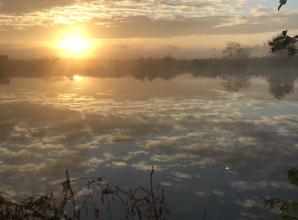
Care, therefore, must also be collective. This is not about erasing difference or dismantling governance overnight. It is about aligning decision-making with ecological reality — something our current systems consistently fail to do. The catchment area of the River Thames makes this visible. From its source to the sea, the Thames connects farmland, towns, cities, and millions of people.
Yet responsibility for its health is fractured across multiple authorities, regulators, water companies, and political priorities. No one holds the whole river. No one truly speaks for it.
Under a bioregional tree, this fragmentation becomes null and void. The river is one living system, therefore its care must be too. Many of the crises facing the Thames — sewage pollution, biodiversity loss, chronic mismanagement — are symptoms of this disconnect. In a world organised around catchments rather than convenience, much of this simply would not happen.
I’m part of a group called Bioregional Thames and I recently spoke with its co-creator, Richard Coates, about how he sees the movement.
Richard says: “For me, Bioregioning is about reconnecting with our place, where we live and who we are. When we do, we are revitalising our collective health.
“Every place on Earth is unique. We need to feel deeply part of our place, to deeply care about where we live, so that we can wisely help the health of where we live and the planet as a whole.
“Bioregioning invites us to explore the unique patterns of our place (geology, hydrology, agriculture, history, culture etc) over time which have shaped our lives without us realising and will continue to influence what works where we live. Most of the settlements along the Thames in some ways have been inhabited by people for thousands of years.
“Dorchester has settlement records going back to 5000 BC. Water is essential for life, so we have always lived near water. Over a long period of time, the Thames gradually eroded its way through the chalk of the Chiltern Hills to create the Goring Gap. Isambard Kingdom Brunel followed this natural pattern by building the Great Western Railway largely following the River Thames, as the gradients were not as severe.
“Seeing people rowing I can imagine the long history of Vikings rowing up the River Thames or neolithic settlers with coracles (boats made of willow and cow hide). Chalk geology leads to lower soil nutrients, which leads to plants which can grow in these conditions and then the pollinators which feed from these plants and the birds who feed on these pollinators.
“Most of the chalk rivers in the world are in England. The clear, filtered water provides a unique ecosystem for invertebrates and fish. Fluvial deposits around the river have created fertile land for agriculture. Buildings reflect local geology, for example with flint being very prominent also where there are deposits of chalk, particularly noticeable in churches, walls and houses.
“We have artificially seen ourselves as separate from nature for hundreds of years now and can feel the consequences. By coming back to seeing ourselves as nature, as life, we are better able to make decisions where we live. For example, we are approximately
70 per cent water and our water comes from the rivers and aquifers of our place, so how do we as mostly water want to treat who we are mostly made up of?
“Life is a web of relations and, for me, Bioregioning helps us learn to see and feel those relations again and play our role in revitalising them.”
So, at the heart of bioregionalism is a fundamental shift in relationship. I’ve spoken of this many times before, but with the world in chaos, this important message is being lost. Nature is not a resource. It is a living system that requires care, respect, and protection. This understanding is now finding legal expression through the growing Rights of Nature movement, which recognises rivers and ecosystems as entities with the right to exist, thrive, and be restored.
This is not idealism. It is a practical response to ecological breakdown. Rights of Nature does not remove humans from the picture. It redefines our role — from controllers to guardians.
This is the thinking behind the work I am doing with Paul Powlesland and Lawyers for Nature to roll out a River Guardianship Network nationally.
River guardianship creates legal and civic structures that ensure rivers are represented, defended and cared for — consistently, not occasionally. It brings responsibility back into relationship with place.
Within the Thames catchment, guardianship has the potential to reconnect communities upstream and downstream, embed long-term care and give the river a voice in decisions that affect its future.
This is bioregionalism made tangible.
Bioregionalism is often dismissed because it challenges deeply embedded systems built on separation, extraction and control. But, what is truly naïve, is believing that those systems — the very ones driving ecological collapse, displacement and division — will somehow save us.
Bioregionalism does not offer a return to the past. It offers a way forward rooted in reality — in land, water, community and care. It asks us to remember where we live, what sustains us and what we owe in return.
And if that is naïve, then perhaps naïveté is not the problem but the beginning of repair.
For more information about becoming a River Guardian, visit www.friendsofthethames.org/river
guardiansnetwork
To discover bioregionalism for yourself, visit www.bioregion.org.uk/bioregionin