09:30AM, Monday 01 December 2025

A FRIEND of murdered schoolboy Olly Stephens has urged parents to normalise “uncomfortable conversations” with their children.
Demi Urquhart spoke about the reality of being a teenager in today’s world and the online pressures young people face, in front of a group of residents.
The 18-year-old attended Emmer Green Primary School with Olly, who was 13 when he was fatally stabbed in January 2021.
The murder took place in Bugs Bottom, an area of open parkland near to Olly’s home. He had been lured to the field by a 13-year-old girl, where he was then ambushed by two boys aged 13 and 14. The youngest then stabbed Olly twice.
Miss Urquhart spoke at the event organised by Caversham and District Residents’ Association held at St Barnabas’s Church on Wednesday last week.
Olly’s mother, Amanda Stephens, talked about the launch of a new charitable trust set up in her son’s name and warned against the harm that “unrestricted access” to social media can have on children.
Miss Urquhart said she wanted to raise awareness about the elements of social media that she believed many children were “too scared” to talk to their parents about, including violent videos or being pressured into sending pictures.
She recalled how social media content shifted quickly from watching “slime” videos when in primary school to clips of other children being “patterned” (humiliated) when at secondary school.
“By Year 7, my feed was filled with clips of people being patterned,” she said. “Not only are violent videos spread so freely but they begin to feel normal.
“I feel like when Olly died, the reality of online harm became impossible to ignore. It wasn’t something on a screen anymore — it was real. It made me realise how dangerous online culture can be. I was only in Year 7 when I started seeing harmful things online, so I can only imagine how much younger the people facing it are now.”
Miss Urquhart said that social media was also promoting harmful beauty standards for young teenagers. She said: “It plants unrealistic expectations into young people’s minds, which can grow into eating disorders and suicidal thoughts.
“When someone feels that way, the algorithm on the internet makes it frighteningly easy to find harmful content on how to stop eating and how to hurt yourself.”
Miss Urquhart said she had seen an increase of violence in real life because of rumours started online.
“I think social media can affect boys and girls in different ways. For boys, it often pushes them towards the violent side. It glorifies drugs, gangs and aggression as something to be proud of. It creates this idea that if they don’t live up to those standards, then they are ‘soft’ or ‘weak’, which can drag them into really dangerous situations.”
Miss Urquhart also raised concerns about the pressure on young girls to send nude pictures of themselves to others online.
“I feel like it’s a topic that’s not spoken about enough,” she said. “So many girls feel ashamed and are left carrying the blame of boys who push and beg for these pictures, and often face no consequences.”
Miss Urquhart said that her advice to parents was to hold off giving their children a phone for as long as possible but that, if that point had passed, to “normalise uncomfortable conversations”.
She said: “Parents need to understand that children can be groomed into situations like this.
“Anger or shame will only push them further away and, instead, they need to show support and listen and understand and help their child find a way out.
“I can only imagine how uncomfortable it would be to tell your mum that you sent a naked photo. But this is such a real issue now and I feel like if parents react with judgment or punishment, their child will only shut down.”
Since Olly’s death, his mother, Amanda, and father, Stuart, have joined the Bereaved Families for Online Safety initiative, supported by the NSPCC, to campaign for a safer internet for children.
They are one of 11 bereaved families who all claim social media played a part in their children’s deaths, from the promotion of suicidal content to dangerous online challenges.
The couple have now launched Olly’s Work, a charity set up in their son’s name which aims to educate about online safety and teach young people about the choices and consequences of knife crime.
Mr and Mrs Stephens have also been instrumental in pushing for the Online Safety Act, which received royal assent in 2023.
The bill means that Ofcom can now take action on the tech companies that are not adequately protecting children.
However, Mrs Stephens said that the group is still fighting for “safety by design” and the removal of harmful content before children see it.
She said: “Violent, horrendous, harmful images are shown to children, and they begin to think that those images are normal. The algorithms are set to feed more and more similar images and content. You cannot escape from the harm you are seeing. They are bombarded.”
Olly had met the boys who murdered him a handful of times in real life and they had first met through online group chats. The boys had talked about their plan to attack Olly on Snapchat and had met the girl they eventually recruited to set him up online.
Mrs Stephens said: “Olly’s murder was planned, calculated and organised online. Many young people were aware of what was going on but no one intervened. No one said ‘stop’. No one sought help from a trusted adult.”
Videos of the boys showing off knives were found on their mobile phones and many of the voice notes recovered by the police discussed knives.
More than 90 per cent of the evidence gathered and presented at trial was taken from mobile phone data.
Mrs Stephens recalled that her son had enjoyed attending Emmer Green Primary School but had struggled when he started secondary school at Highdown and found the transition “extremely difficult”.
Olly was diagnosed as autistic shortly before his murder and Mrs Stephens explained that this, together with the pressures of covid-19 lockdowns and his behaviour at school, led him to become excluded.
She said: “Like many parents, we gave Olly a smartphone in Year 6. He had wanted to walk to school so a phone would ensure he was safe when travelling to and from school.
“We now realise that a smartphone did not make Olly safe but exposed him to harm.
“So-called normal, real-world childhood playground arguments in the online world can quickly escalate out of control and lead to murder.
“So many families suffered, and lives were destroyed that afternoon. And for what? An online argument. Now Olly’s Work is his legacy.”
For more information, visit www.readingamnesty.art/
ollyswork/
Most read
Top Articles

Archive image of the entrance to Newlands Girls' School (Google)
A former head of music at Newlands Girls’ School in Maidenhead has been banned from teaching indefinitely over a litany of ‘sexually motivated’ advances on students.

It’s the ‘end of an era’ for Maidenhead Golf Club after members played a final round at their Shoppenhangers course before moving off.
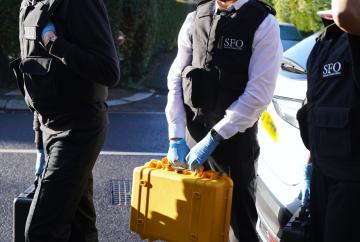
A home in Maidenhead was raided this week as part of a Government investigation into suspected bribery and fraud by the past management of a social housing company.
© Copyright 2024 Baylis Community Media CIC All right reserved