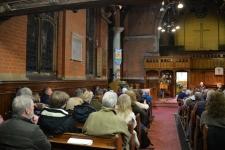
Affordable housing couldn't be secured for Maidenhead Spiritualist Church redevelopment.
Windsor and Maidenhead council is hoping to gain a better foothold in debates with developers over affordable housing using new published guidance.
RBWM has 'relatively low' historical levels of affordable housing, in particular from 2015 to 2019 – just 2.5 per cent of new housing was affordable in 2015/2016.
On Monday, members of the Place Overview and Scrutiny panel opted to approve a draft Supplementary Planning Document (SPD), hoped to help change this for the better.
An SPD provides further detail to policies in an authority's Local Plan – in this case, the Borough Local Plan (BLP).
The Affordable Housing Delivery SPD provides more detailed guidance to support RBWM’s affordable housing policy, to steer developers towards its aims, reducing back-and-forth and disagreements.
Key elements
Some key elements of the guidance include:
Within types of affordable housing, the BLP aims for 45 per cent social rent, 35 per cent affordable rent and 20 per cent shared ownership.
Social rent is 'the most affordable form’, providing the greatest discount - thus is more costly for developers to provide.
‘Affordable rent’ is more expensive, but should be no more than Local Housing Allowance rents. This means these can be made affordable to those who receive benefits.
As for shared ownership, this should be ‘more than a small discount' off the market value.
Looking at types of homes, the SPD places greater emphases on two-bed rented houses rather than flats.
Economic viability and legal challenges
Ian Manktelow, RBWM’s principal planning policy officer, said ‘viability’ is an 'increasing issue’.
This is the extent to which developers can feasibly deliver affordable housing based on the costs.
Applicants have previously argued that taking the lower income from affordable housing would make certain schemes not worth their while.
"Developers will challenge the local authority, turning around and saying they can't deliver 30 per cent of 40 per cent affordable housing, the economics don't stack up,” said Mr Manktelow.
"They are entitled to do that under the BLP and national policy – we can't set policies and requirements that make development unviable.”
If RBWM refuses a scheme over a lack of affordable housing when the developer believes this is unviable, they could launch a costly legal challenge against the Borough.
Mr Manktelow said that national policy is weighted in favour of home building – and RBWM must be careful because planning appeals are 'risky'.
"You probably have to pick your battles,” he said.
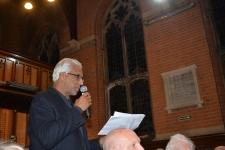
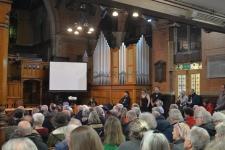
In the appeal for the Maidenhead Spiritualist Church redevelopment last year, RBWM dropped affordable housing requirement as a defence for its decision, realising that it could probably not justify its stance to an inspector.
Because of issues like this, pinning down viability is a 'key' part of the SPD. Then at least, RBWM can set guidance to make sure viability assessments ‘are done in the right way.’
RBWM can also have 'review mechanisms' that allows it to revisit the affordable housing issue part-way through development.
"If the viability improves, say if the market picks up a couple of years down the line, we maybe secure more affordable housing or additional financial contributions,” said Mr Manktelow.
Financial contributions in lieu of building affordable homes
Another important part of the SPD is an affordable housing financial contributions calculator – letting developers see how much money they should pay RBWM in lieu of building affordable housing.
In short, if for some reason a developer can’t include affordable homes within its scheme but the scheme is large enough to require it, the developer can make a financial contribution instead.
The calculator is a ‘simple tool’ hoped to 'reduce debate' with developers about these contributions.
But Mr Manktelow was keen to stress that this was not about creating a 'choice' for developers between building affordable housing and contributing financially instead.
"We don't want to give them the choice. We want as far as possible to secure affordable housing on the site.
"It's the tried and tested method of actually getting it provided, and integrating affordable housing with market housing.”
Tenure mix and housing need
As a rule, RBWM wants housing schemes to be 'tenure blind' no noticeable difference between afford and market housing.
Though not common, developers may try to put more affordable homes on one site and less on another that they think is more commercially favourable for market housing.
"Generally that's not a good solution in terms of creating community - there need to be some good reasons for doing it,” said Mr Manktelow.
For example, a site may feature a specialist housing scheme, shelter schemes or suchlike. These aren't necessarily best placed in the same place as market housing.
Members of the panel expressed their approval for the new SPD. Councillor Gurch Singh (Lib Dem, St Mary’s) said it was ‘closing up a loophole' that has existed for years.
"Our housing list is increasing and has been year-on-year for the past decade. We're not delivering enough affordable housing,” he said.
"This will release the hand that's tied behind our back while negotiating."
Planning process and debates with developers
Another aim of the SPD is to encourage developers to provide as much information as possible in the first instance to make sure applications are compliant earlier in the planning process.
Mr Manktelow highlighted that once an application is validated, the ‘clock is ticking’ and the council wants to avoid spending too much of its time chasing information that is not there.
Cllr Clive Baskerville (Lib Dem, Pinkneys Green) said he hoped the SPD gave the council ‘more clout’ and said there was a perception that RBWM had ‘meekly accepted' developer’s claims over viability in the past.
He queried if it's 'really that tough' for developers – he felt developers may have been 'getting the violins out' and 'laying it on a bit thick.’
Mr Manktelow said RBWM tries its best to ‘ignore the violins’ and this document will help all parties know where they stand.
Andrew Durrant, RBWM’s executive director of place, added that the council has at times been able to challenge developers’ schemes and come to agreements regarding them.
Most read
Top Articles
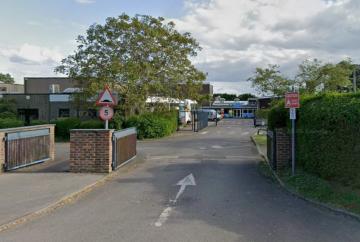
Archive image of the entrance to Newlands Girls' School (Google)
A former head of music at Newlands Girls’ School in Maidenhead has been banned from teaching indefinitely over a litany of ‘sexually motivated’ advances on students.

It’s the ‘end of an era’ for Maidenhead Golf Club after members played a final round at their Shoppenhangers course before moving off.

Police were called to the Jubilee River in Datchet shortly before 10am on Monday following reports of someone in the water.
© Copyright 2024 Baylis Community Media CIC All right reserved