05:30AM, Friday 25 April 2025

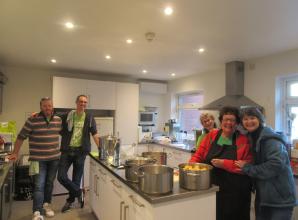
'A fantastic team': staff at Thames Hospice's Maidenhead Homestore.
Thames Hospice’s charity shops play a vital role in funding its care, with donations making a real difference. But not everything dropped off is helpful.
As spring cleans begin, The Advertiser has explored the hidden cost of unsellable items – and why it matters more than ever.
Ringing tills at Thames Hospice’s shops are a vital part of an enormous drive to raise more than £12million each year.
And donations of the items those shops sell are a backbone that helps the hospice provide end-of-life care to the thousands of people across the Thames Valley it does each year.
Yet each year, unsellable items – chipped crockery, damaged clothing, odd shoes, and hundreds of coat hangers – continue to arrive.
It is a £100,000 problem.
Julie Rowley, Thames Hospice’s director of retail, said: “We can’t survive without donations from the general public and we really, really appreciate their generosity that allows us to generate the income that we do.
“But in amongst that is the battle of items left outside our stores, damaged items arriving beyond repair, that are completely unsellable and hence we have to dispose of them.”
As Thames Hospice’s retail arm grows in importance, raising about one third of the hospice’s £18million running costs each year, so too does maximising the value of each donation it receives.

Thames Hospice is raising awareness about the importance of donations.
Its charity superstore, opened last year, has a repair area and a tailoring service to breathe life back into old items.
There is nothing staff and volunteers can do though, when items arrive too damaged to sell or are left outside its shops in the elements overnight.
Claire Done, an area manager for the hospice, has worked with its charity shops for 12 years and started as a store manager in its Maidenhead branch.
She has seen problem donations first-hand.
“We don’t want to lose those precious items that people have kindly donated to us,” Claire said.
“Some shops are closed on a Sunday and things that might be left outside overnight – we can end up losing a lot of items that we could have sold.
She added: “It’s classed as fly-tipping if it’s left by the road – and we have to pay to dispose of that if it’s left by the road.”
When seemingly good donations do arrive, staff sifting through them can also unearth other unwanted items.
Single shoes, games and jigsaw puzzles with missing pieces. And hundreds of coat hangers.
Thames Hospice has its own hangers for clothing and so has to dispose of any it receives.
“It could also come down to health and safety,” Claire added.
“Chipped crockery; we couldn’t sell that, that could cause a problem in the store.
“Toys and games; restrictions in the UK say they to have a CE mark on them – electrical items too.
“We have to test all of our electrical items when we receive them and they do have to be in a reasonable working order.”
CE is a certificate proving an item complies with health and safety laws.
Julie said: “We really want donations and if anyone knows our shops, they’ll know that we pride ourselves on really caring for the donations we get.
“Particularly as we want to maximise what we can sell the items on for.
“We really do care for how we present them and there’s nothing more disheartening than when you see a whole load of things outside that have just been spoiled, damaged or broken.”
Costs count for Thames Hospice, which is faced with pressures from a National Insurance hike and other inflationary rises.
The £100,000 it is forced to spend on disposing of unsellable items is equivalent to 500 nurse visits to people receiving care while living at home.
Demand for end-of-life care is rising, with more people living longer with life-limiting conditions and people living to be much older.
Thames Hospice’s care in the community is a growing variety of care offered in patients’ homes, in addition to what it provides at its Bray base.
Discussing the £100,000 figure, Julie said: “That’s a big powerful number and represents a lot of people we would be able to help.”
The charity wants to raise awareness of the cost of unsellable donations, while still encouraging people to donate.
Thames Hospice needs donations more than ever.
Claire said: “We always love seeing good quality clothing arrive, clean clothing; paired shoes that are together; good quality homeware.”
And while the donating to hospice stores is a great way to support, there are other ways to help.
The call for volunteers is always open and welcome.
Claire said: “If anyone has spare time and wants to come in to help for just a couple of hours if they live locally, the team is fantastic and they’re very welcoming.”
Julie said: “We are the window to the organisation and we are relied upon to keep our tills ringing to help support the income that we need.”
You can find out more information about Thames Hospice’s What We Love campaign on its website at tinyurl.com/2j4czer7
More information about volunteering opportunities is available at tinyurl.com/mvtnh9cz
Most read
Top Articles

Police were called to an address in Dunholme address earlier this year (archive image)
Police were sent to a house in Dunholme End on the evening of June 10, where a four-year-old boy was pronounced dead at the scene.

Drivers are being advised to follow diversion signs due to the closure
Drivers using the M4 between Slough and Maidenhead have been warned to expect disruption as emergency services battle a fire on a heavy goods vehicle.

Police officers were called to the Shell Garage in Burnham Lane shortly before 1.45am on Tuesday following reports a woman had suffered serious injuries.
© Copyright 2024 Baylis Community Media CIC All right reserved